FANUC CNC Repair in Southern California
Share Post
FANUC Controls, Drives and Alarms, Diagnosed On-Site
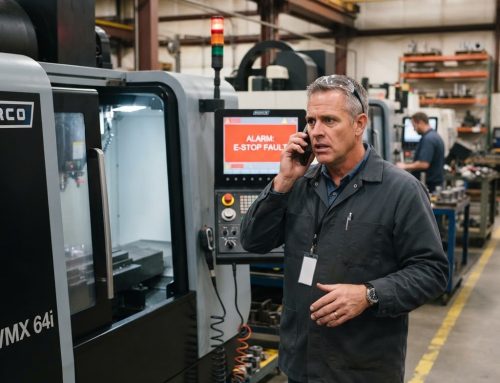
FANUC controls run a large share of the machining and turning centers on Southern California shop floors, from Series 0i machines still cutting every day to 30i-A and 31i five-axis cells. When one of them drops into an alarm, the operator sees a number and the shop sees a stopped spindle.
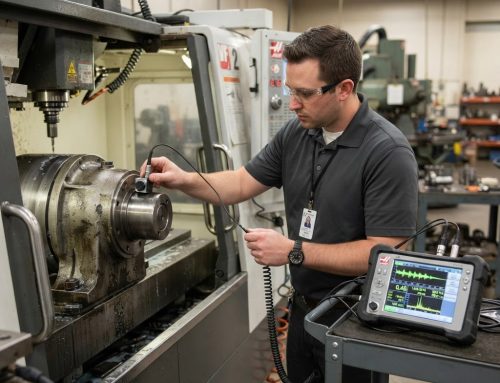
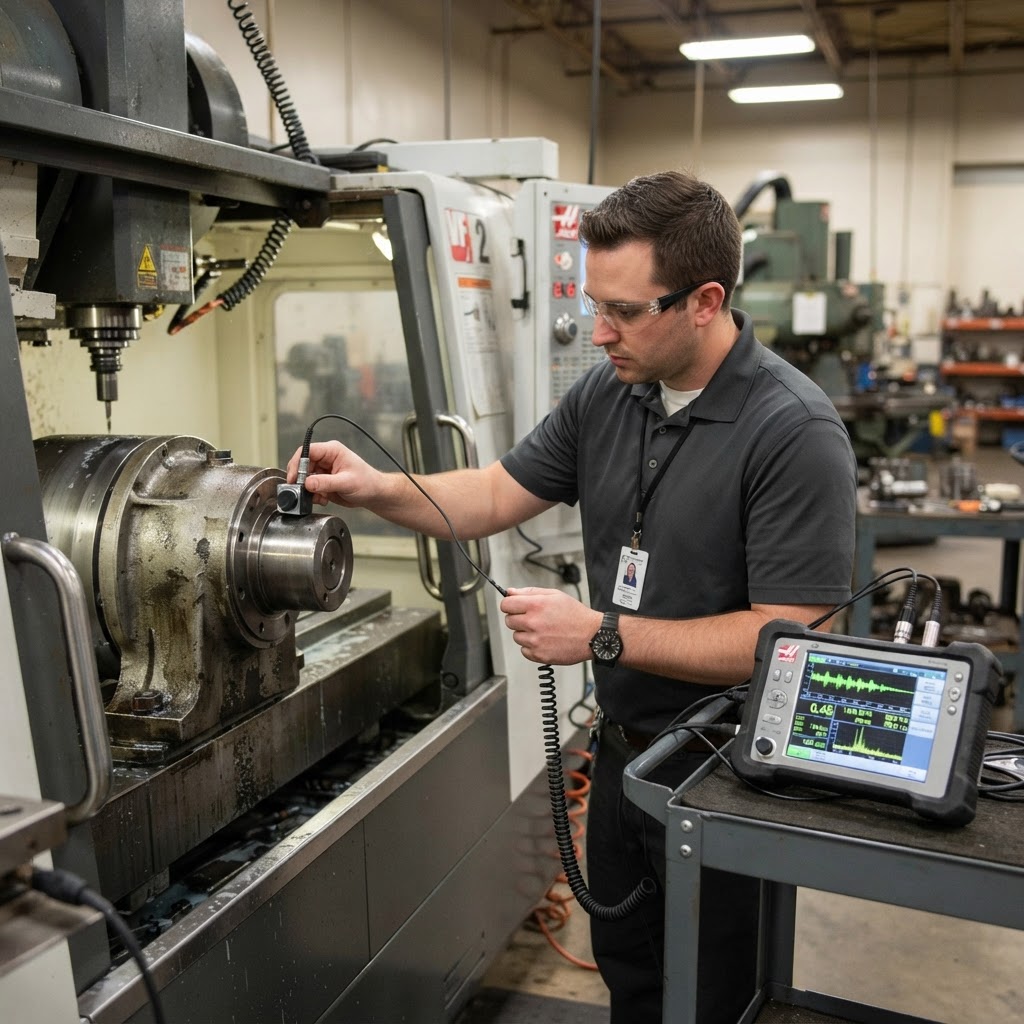
In-House CNC Service sends mobile technicians from our Menifee base to your machine to diagnose the FANUC control, the servo and spindle drives, and the mechanical or electrical fault behind the alarm. We back up parameters and ladder before we touch hardware, and we leave with the machine running or with a written reason it cannot. Call (951) 540-4820.
FANUC Controls, Drives and Feedback Systems We Repair
FANUC service is control-cabinet work and machine work at the same time. A servo alarm can come from the amplifier, from the motor, from the cable in the drag chain, or from a mechanical bind that overloads the axis. We carry the diagnostic tools and the control knowledge to follow the fault to its actual source instead of replacing parts until the alarm stops.
Common FANUC Alarms We Diagnose
The alarm number narrows the search before the cabinet door opens. These are the alarms that stop Southern California machines most often, and what they usually turn out to be. The number is a starting point, never the diagnosis: the same alarm can come from a board, a cable, a motor, or a mechanical problem the drive is reacting to.
If your machine is down on an alarm you do not recognize, read our breakdown of CNC error codes across FANUC, Haas and Siemens, then call with the alarm number and the machine model. That one call usually tells us what to bring.
What an On-Site FANUC Diagnostic Looks Like
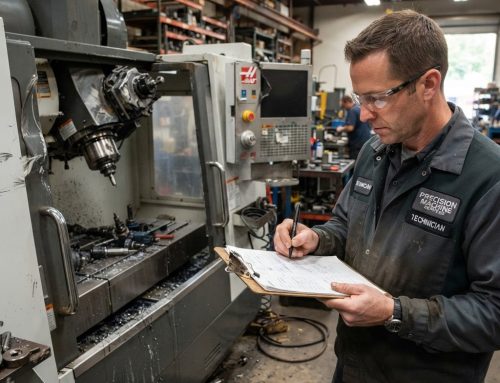
FANUC work goes wrong when someone starts swapping boards before anything is saved. Our sequence is deliberate, and it is the reason a repair does not turn into a re-commissioning job.
Machines We Service That Run FANUC Controls
FANUC supplies controls to a long list of machine builders, so the badge on the casting often has nothing to do with the control inside. We service FANUC-controlled turning centers, vertical and horizontal machining centers, and older iron that is still making parts, including machines from Doosan and DN Solutions, Hyundai-Wia, Methods, Victor Taichung, Yama Seiki, Leadwell, Feeler, Kingston, Hartford, Akira-Seiki, Tongtai and Chevalier.
That matters because the control is where most faults are found. A shop with three different machine brands and one control platform needs one technician who reads that platform fluently, not three factory dispatches.
FANUC Preventive Maintenance and Parameter Backups
The most expensive FANUC failure we see is not a board. It is a dead absolute encoder battery that takes the machine reference with it, or a control memory fault with no parameter backup on file. Both are preventable for the cost of a scheduled visit.
Our preventive work on FANUC machines covers battery condition and replacement before the warning becomes data loss, cabinet fans and filter cleaning, heat and contamination checks inside the enclosure, spindle and axis verification, parameter and ladder archive to a file you can actually find later, and a written record of what was replaced and when.
For shops that want this on a schedule, see our CNC preventative maintenance program.
Repair, Rebuild, or Retrofit: How We Decide
Not every FANUC problem should be repaired. The honest question on a dead machine is whether a repair restores reliable production, or whether you are paying to postpone a bigger decision. We price it that way and say which one we think you are looking at.
Repair is the right call when the fault is isolated: a drive, a cable, a battery, a fan, a single axis motor, or a control board with a known replacement path. Turnaround is measured in days and the machine goes back to work with its parameters intact.
Rebuild makes sense when the control is healthy and the mechanics are not, or the reverse. A spindle that has lost preload or an axis that will not hold tolerance is a mechanical job, and replacing electronics to chase it wastes money. Conversely, a control that keeps corrupting parameters is a control job, and shimming the mechanics will not fix it.
Retrofit becomes the smarter number when boards for an older control are unavailable or the cost of repeated failures passes the cost of a control replacement. A retrofit is a project, not a repair, and it comes with downtime, re-commissioning, documentation and operator adjustment. We will tell you when that is genuinely the cheaper path over three years rather than sell you one today.
What we will not do is keep replacing parts on a machine whose real problem is mechanical. That is a pattern we see often on older FANUC-controlled lathes, and it is expensive for the shop.
Independent FANUC Repair vs. the Factory Service Queue
FANUC America has a service organization and a parts channel, and for warranty work and control-level rebuilding there are jobs that belong with them. For a shop with a machine down today, the difference is usually response and scope: an independent technician arrives with the meter, the ladder, and the ability to look at the mechanical side of the problem too.
We are not a FANUC dealer and we do not present ourselves as one. We are a multi-brand field service shop that works on FANUC-controlled equipment every week, and we will tell you when a job genuinely belongs with the factory. For the trade-offs in detail, read FANUC America vs. independent FANUC repair.
Official FANUC product and support information is published at FANUC America.
FANUC Service Coverage Across Southern California
We run FANUC service out of Menifee, which puts most of the region inside a normal service day: Los Angeles and the San Fernando Valley, Orange County, the Inland Empire including Riverside, Corona, Ontario and Temecula, San Diego County, and the Ventura County line.
For the Los Angeles basin specifically, our Los Angeles CNC repair page covers response and coverage in more detail. We also run dedicated drive-and-control service for other platforms, including Mazak and Okuma machines.
If you need a budget figure before you commit, our CNC machine repair cost guide breaks down what drives the number.