FANUC America vs. Independent FANUC Repair: What Shops Need to Know
Share Post
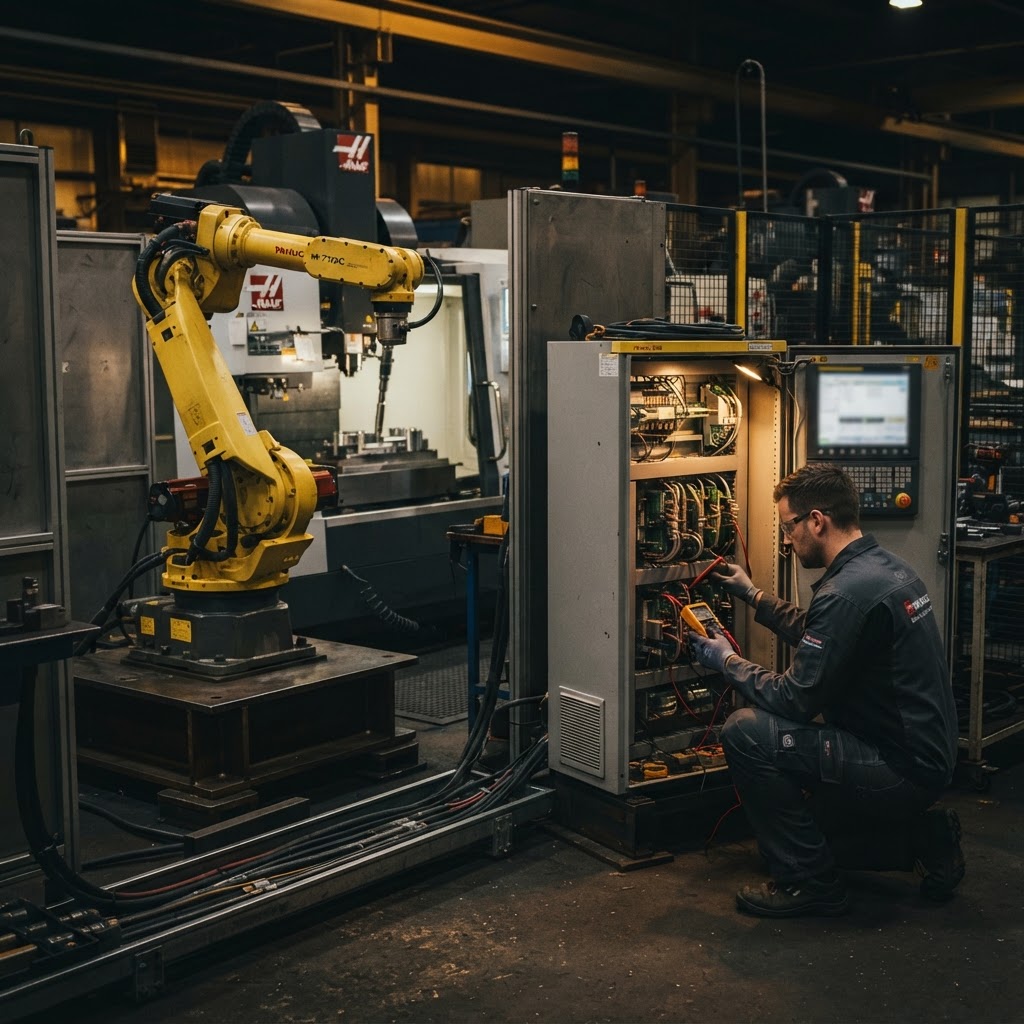
The Choice Every FANUC Shop Eventually Faces
FANUC is the most widely installed CNC control platform in North American manufacturing. When a FANUC-controlled machine goes down, shop managers face a decision: call FANUC America for factory service, or work with an independent FANUC technician. The right answer depends on the specific situation u2014 and understanding the real differences matters for production shops where downtime cost is measured in thousands of dollars per hour.
FANUC America Service: Strengths and Limitations
FANUC America provides factory-trained technicians, OEM replacement parts, and work backed by FANUC’s warranty program. For shops with FANUC service contracts, response times can be competitive. For out-of-contract service calls, lead times frequently stretch to one to two weeks for a field service appointment in most markets.
The primary limitation is cost and scheduling flexibility. FANUC America’s labor rates reflect OEM overhead, and their service scheduling is driven by their regional coverage model u2014 not your production schedule. For shops in Southern California outside of major metropolitan centers, response times can extend further.
FANUC America’s parts warehouse is comprehensive for current-generation controls and drives. For legacy systems u2014 Series 0, 10, 15, and older 16/18 series u2014 parts availability through FANUC becomes inconsistent, and lead times on backordered components can run six to twelve weeks.
Independent FANUC Repair: What to Look For
The independent FANUC repair market in Southern California ranges from qualified, experienced technicians to less capable operators. The critical differentiators are hands-on experience with the specific control series, access to quality spare components, and the ability to perform on-site diagnosis rather than just board swaps.
A qualified independent technician should be able to read FANUC ladder diagrams, interpret servo and spindle alarms at the parameter level, perform drive tuning, and back up and restore machine parameters. These are diagnostic skills u2014 not just part replacement. Shops should ask specific questions about experience with their control model before scheduling service.
Cost Comparison: A Realistic Look
For a typical FANUC servo drive failure u2014 one of the most common repair scenarios u2014 the cost difference between FANUC America service and qualified independent service is meaningful. FANUC America labor rates typically run $200 to $300 per hour plus travel. An experienced independent technician in Southern California typically bills $150 to $200 per hour with lower or no travel overhead for shops within their service area.
For shops within In-House CNC’s service coverage, the combination of faster response and lower labor cost typically results in 30 to 50 percent lower total repair cost compared to FANUC America factory service for most common failure modes. And the response time difference u2014 same day or next day versus one to two weeks u2014 translates directly into recovered production hours.
When Factory Service Is the Right Call
FANUC America service makes the most sense in a few specific situations: warranty repairs on new machines covered under FANUC’s warranty program, repairs requiring proprietary FANUC diagnostic tools not available to independent technicians, and certain servo motor rewinds and spindle motor repairs that require FANUC’s rebuild facility.
For the majority of field repair situations u2014 drive faults, control board failures, parameter issues, axis faults, and spindle amplifier problems u2014 a qualified independent technician delivers equivalent technical capability with faster response and lower cost.
In-House CNC: FANUC Service in Southern California
In-House CNC Service provides on-site FANUC repair throughout Southern California. We work on all current and legacy FANUC series including 0i, 16/18, 21i, 30i, and 31i. Call Jason at (951) 540-4820 to discuss your machine’s situation and get an honest assessment of the repair before committing to any service path.