CNC Machine Repair Case Studies: Real Problems We’ve Solved
Share Post
The Critical Role of CNC Machine Reliability in Southern California
n
In the highly competitive manufacturing landscape of Southern California, machine tool downtime is the ultimate profit killer. Whether you are running a high-precision aerospace facility in Riverside, an automotive tier-one supplier in Ontario, a high-tech medical device shop in Irvine, or a heavy-duty industrial fabrication shop in Corona, your CNC machines are the absolute heart and soul of your business operations. When a spindle screams to a sudden halt, a servo drive errors out, or a control board goes black, production lines freeze, delivery schedules slip, and revenue evaporates instantly. The ripple effects of an unexpected machine failure can be felt across your entire organization, causing severe scheduling headaches, stressed machine operators, and critical delays in shipping finished products to your customers. In high-stakes manufacturing, reliability is not a luxury; it is a necessity for survival.
n
At In-House CNC Service LLC, we specialize in rapid, precision on-site CNC machine repair. Under the leadership of Jason Wutzke, our Menifee-based team serves machine shops throughout Riverside County, San Bernardino County, Orange County, and San Diego County. We understand that real-world problems demand real-world, highly specialized solutions. We don’t just treat the symptoms of a machine failure; we identify and eliminate the root causes, whether that means repairing a complex lubrication line, replacing a bad cooling fan, or routing a high-flex cable correctly. To show you exactly how we work and the level of technical expertise we bring to every single service call, we have compiled five realistic case studies based on composite repair scenarios we solve daily across the SoCal region.
nn
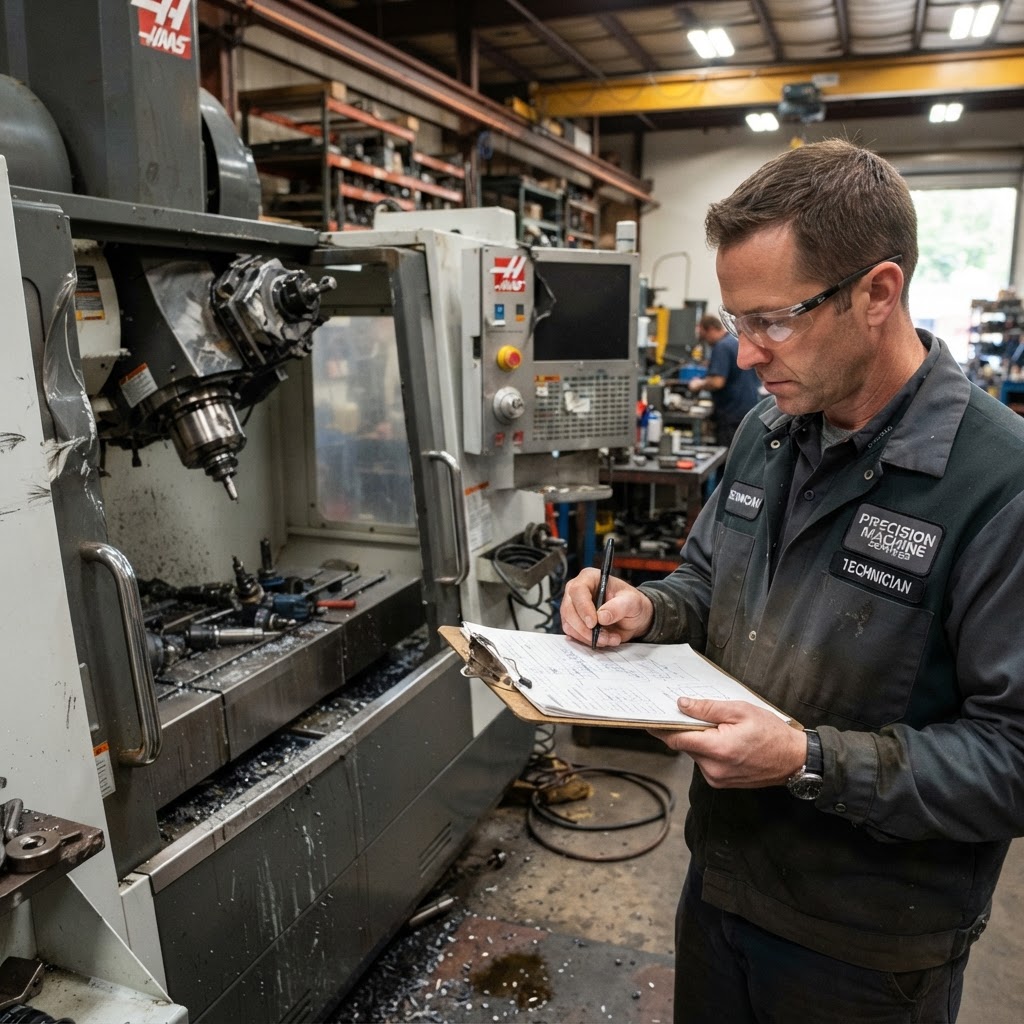
Case Study 1: Spindle Crash Recovery at a Riverside Aerospace Shop (Haas VF-4)
n
The Scenario: An aerospace job shop in Riverside, California, was in the middle of a high-priority titanium structural bracket run for a major commercial defense contractor. During a late-night shift, a programming tool-path error led to a severe, high-impact Z-axis spindle crash. The Haas VF-4’s spindle ground to a violent halt while running at 8,000 RPM. The next morning, the machine suffered from severe, loud vibration, excessive thermal buildup within minutes of idling, and part finishes that were completely out of aerospace tolerance. The shop was facing a catastrophic delay on a critical delivery window, putting their vendor status in serious jeopardy.
n
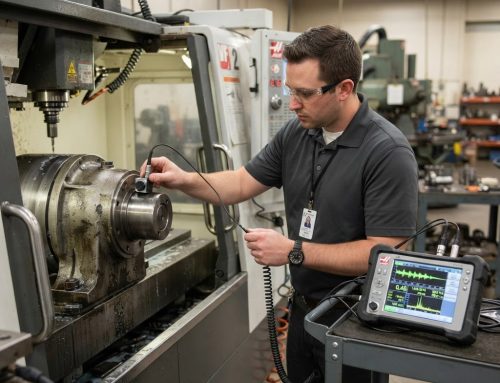
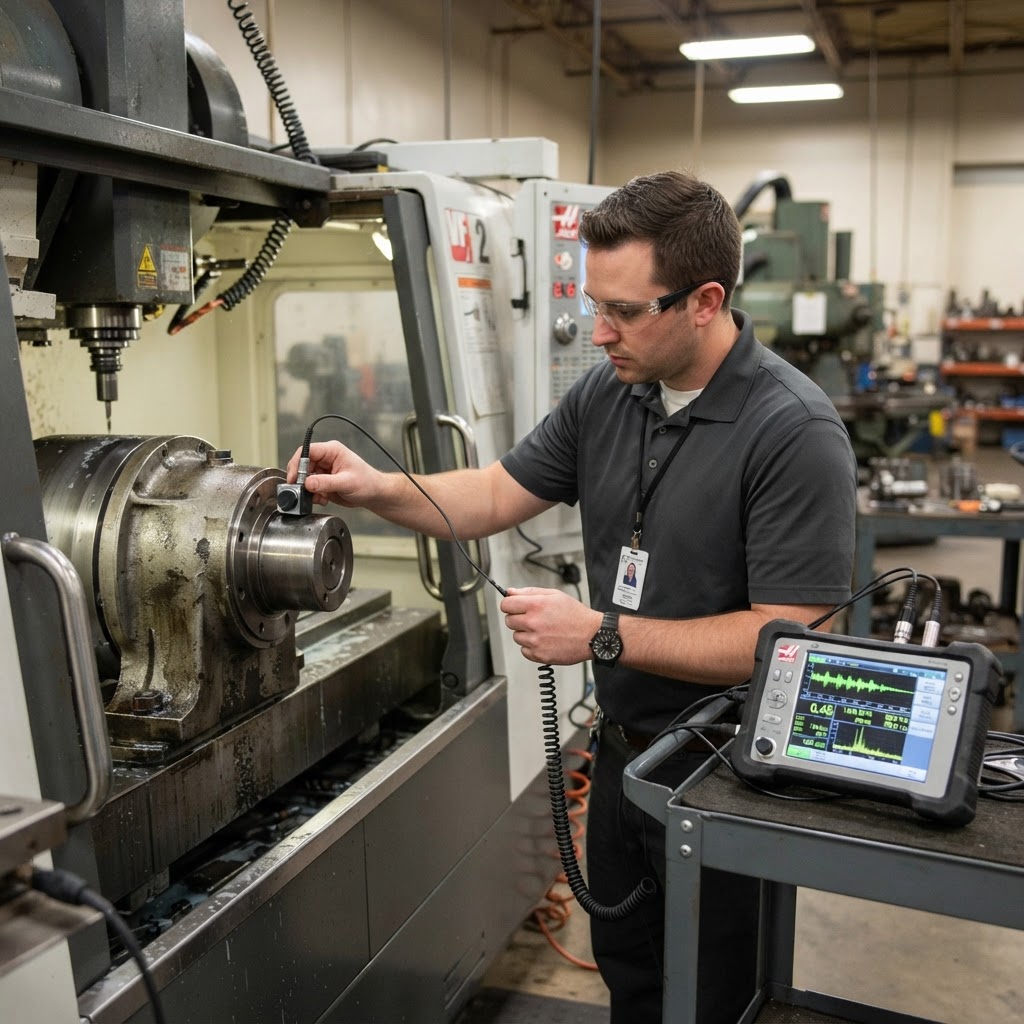
The Diagnosis: When In-House CNC Service LLC arrived on-site, our technician immediately performed a comprehensive vibration signature analysis and a taper contact check. The results confirmed our suspicions: the high-precision angular contact spindle bearings were severely brinelled—meaning the ball elements had dented the hardened steel races under the extreme impact force of the crash. Runout at the spindle taper was measured at 0.0018 inches—nearly ten times the maximum allowable tolerance for precision aerospace milling. Any attempt to continue running the machine would have completely destroyed the spindle housing and ruined expensive titanium raw stock.
n
The Repair Process:n
- n
- Disassembly & Inspection: We carefully disassembled the spindle head assembly, removing the drawbar, drive keys, and the damaged spindle cartridge. We inspected the belt, drive pulleys, and the spindle motor shaft for secondary impact damage. Fortunately, the motor shaft was straight, saving the customer thousands of dollars in motor repairs.
- Cartridge Replacement & Alignment: Since the shop could not afford the weeks-long lead time for a factory rebuild, we sourced a high-quality, precision-rebuilt replacement cartridge. We installed the cartridge, set the exact preload, and meticulously aligned the spindle-to-column geometry.
- Sweeping the Table: We swept the spindle taper using a high-precision dial indicator to ensure the spindle center line was perfectly perpendicular to the X-Y travel plane. Runout was successfully brought back down to a flawless 0.0001 inches, meeting the tightest industry standards.
- Drawbar Force Calibration: We tested and calibrated the drawbar retention force using a digital force gauge, ensuring secure tool holder retention during high-feed milling operations.
n
n
n
n
n
n
The Outcome: Within 24 hours of our arrival, the Haas VF-4 was back up and running at full capacity. The shop met its aerospace delivery deadline, avoiding catastrophic contract penalties and preserving their reputation with the defense prime contractor. By choosing on-site repair, the shop saved over $12,000 in rigging and transport fees, not to mention two weeks of lost production time. This repair highlights our speed and technical precision under pressure.
nn
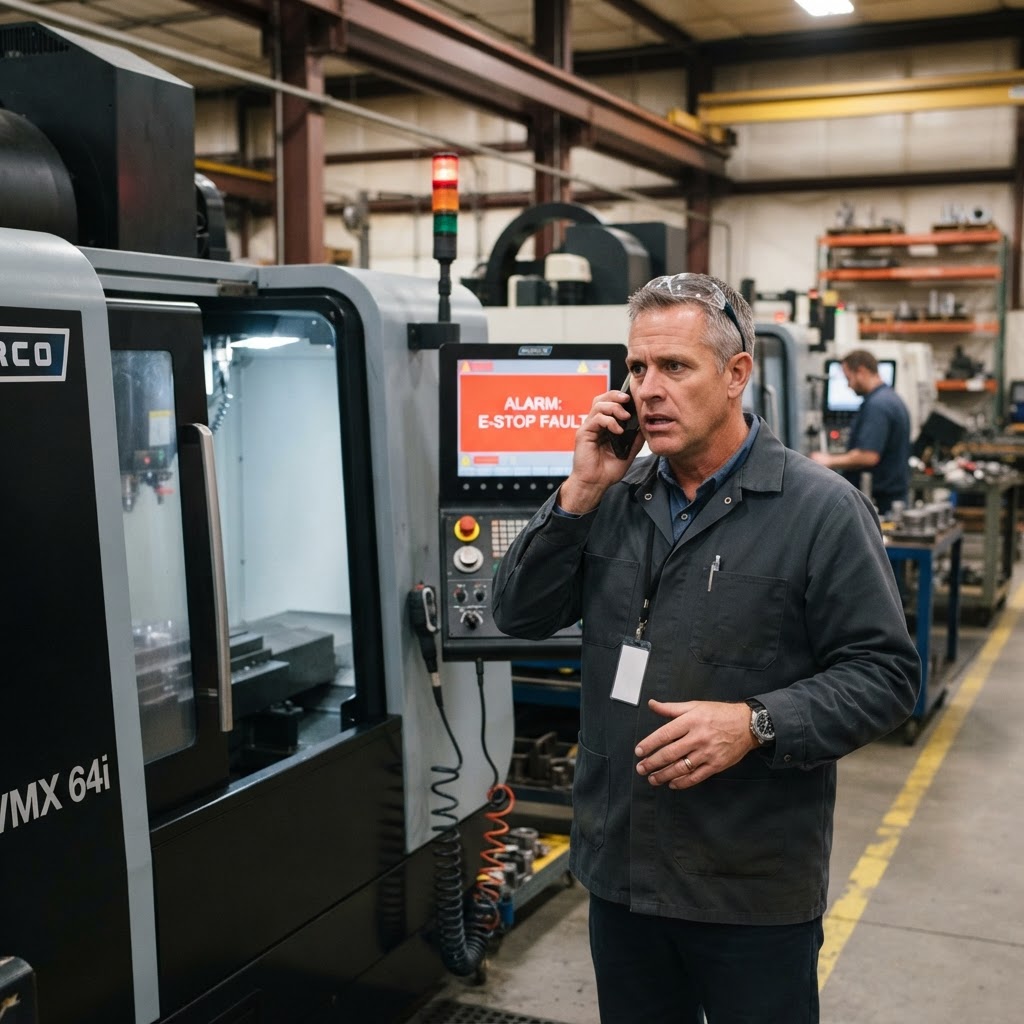
Case Study 2: Axis Drive Failure Resolution at an Ontario Auto Parts Supplier (Fanuc-controlled Lathe)
n
The Scenario: An automotive aftermarket components manufacturer in Ontario, California, experienced a sudden, hard shut down on their main production lathe. The Fanuc Series 21i-TB control screen displayed a persistent SV0368 serial data error and a SV0417 digital servo parameter error on the X-axis drive. The machine was completely dead in the water, blocking a high-volume run of custom aluminum wheel hubs that were scheduled to ship to distributors by the end of the week. The production manager was in a panic as shipping containers were scheduled for loading.
n
The Diagnosis: Our diagnostic routine began by isolating the electrical and mechanical components. We checked the feedback circuit, measuring the resistance of the X-axis pulse coder cable. We discovered severe insulation degradation inside the flexible cable track (energy chain), where years of exposure to hot chips and sulfur-based cutting oils had eaten through the protective polyurethane jacket. This caused an intermittent short circuit in the encoder feedback line, which in turn damaged the internal gate-drive circuitry of the Fanuc servo amplifier module in the electrical cabinet.
n
The Repair Process:n
- n
- Amplifier Replacement: We removed the damaged Fanuc servo drive module from the electrical cabinet and installed a fully tested, high-reliability replacement module.
- Cable Rewiring: We ran a brand-new, high-flex oil-resistant shielded encoder cable from the feedback module to the cabinet, carefully routing it through the energy chain to prevent future mechanical pinch points and abrasive wear.
- Parameter Optimization: We restored the factory motor parameters and encoder settings within the Fanuc system, clearing the digital servo configuration faults and verifying communication stability.
- Testing: We performed continuous rapid-traverse cycle tests to monitor drive temperature, current draw, and feedback accuracy under maximum acceleration curves.
n
n
n
n
n
n
The Outcome: The lathe returned to service, running cooler and drawing less current than it had in months. The Ontario supplier was back to shipping custom wheel hubs to distributors within hours, eliminating a major bottleneck and keeping their warehouse fully stocked. This case shows how minor environmental factors can lead to catastrophic electrical failures, and why robust rewiring is critical.
nn
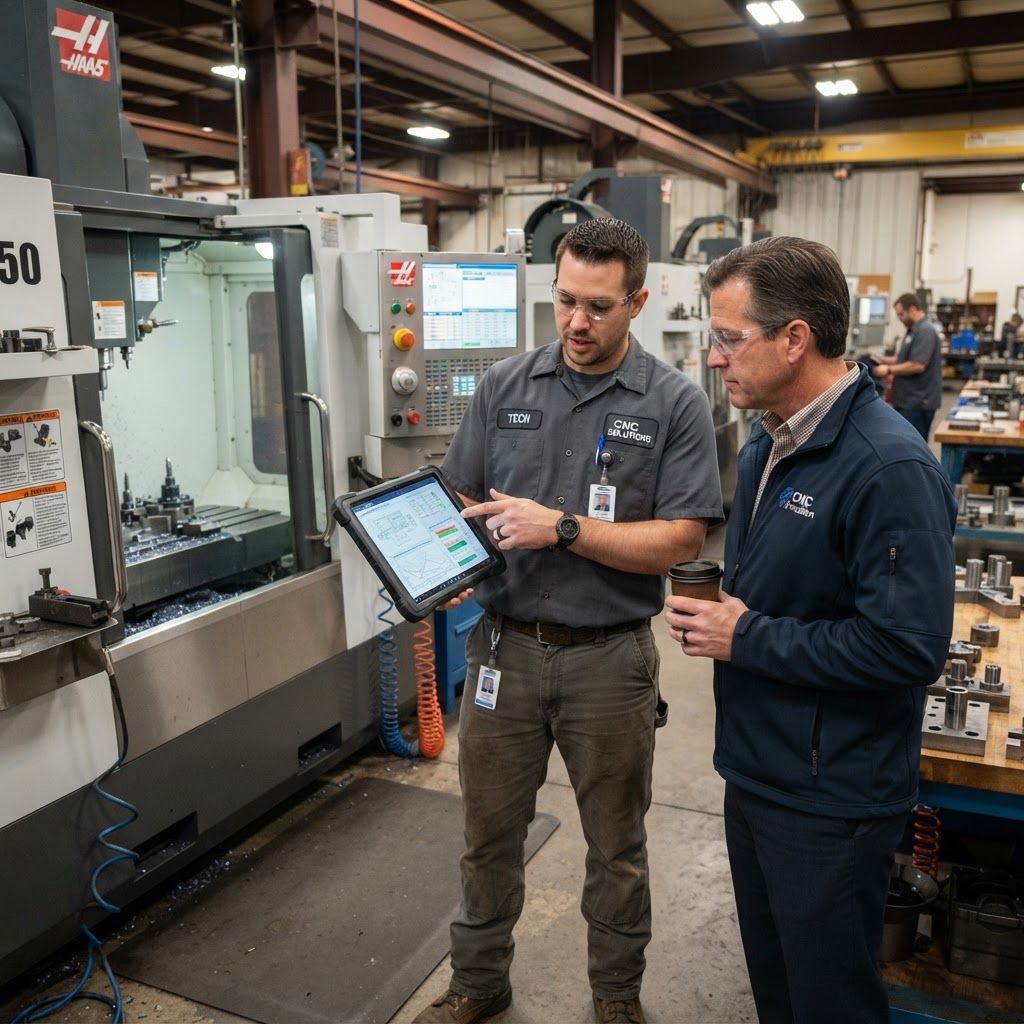
Case Study 3: Main CPU Control Board Replacement in Irvine (Haas Next Gen Control)
n
The Scenario: A precision medical device manufacturing company in Irvine, California, reported that their Haas 5-axis vertical machining center was experiencing intermittent, random reboots, screen freezing, and occasional data corruption. During these events, the machine would lose its active work coordinate offsets, ruining expensive medical-grade PEEK and implantable titanium raw stock and halting production on a critical contract for surgical components. The cost of raw stock alone made these failures extremely expensive.
n
The Diagnosis: In-House CNC Service LLC performed a comprehensive voltage stability test on the machine’s low-voltage power supply. While the power supply itself was stable, we noted thermal imaging anomalies on the main CPU circuit board of the Haas Next Gen Control (NGC). Specifically, a critical microprocessor and several surrounding surface-mount capacitors were running extremely hot. The internal cooling fan in the electrical enclosure had failed, leading to thermal stress and micro-cracking in the CPU board’s multilayer traces, which caused the control to reset when temperatures peaked.
n
The Repair Process:n
- n
- System Backup: Despite the board’s instability, we successfully initiated a full system backup, capturing all machine parameters, macro variables, custom lead-screw compensation tables, and tool library data to an external flash drive.
- Board Installation: We replaced the faulty CPU board with a brand-new assembly, following strict ESD (electrostatic discharge) safety protocols. We also replaced the failed enclosure cooling fan with a high-flow, sealed-bearing unit.
- Firmware & Parameter Restore: We loaded the latest stable Haas firmware version and successfully restored the customer’s unique parameter backups, coordinate systems, and custom macro profiles.
- Grid Shift & Zero Return Re-calibration: Because the board exchange reset the machine encoders, we re-calibrated the absolute home grid-shift parameters on all five axes, ensuring perfect spatial alignment.
n
n
n
n
n
n
The Outcome: The control performed flawlessly with zero freezing, coordinate drift, or data loss. The medical device manufacturer resumed their high-precision runs with complete confidence, knowing their machine was fully calibrated, thermally stable, and operating within the strict tolerances required for medical components. By keeping the backups safe, we prevented a massive parameter reconstruction headache.
nn
Case Study 4: Precision Ballscrew Rebuild and Alignment in Corona (Mazak Integrex)
n
The Scenario: A heavy industrial manufacturing shop in Corona, California, was struggling with severe backlash on their Mazak Integrex multi-tasking machine. X-axis part dimensions were drifting by up to 0.0035 inches during circular interpolation cuts, resulting in out-of-round bores and rejected heavy-duty hydraulic cylinders. The operator was constantly trying to compensate for the error, but the deviation was inconsistent and unpredictable, resulting in high scrap rates.
n
The Diagnosis: Our diagnostic team set up a magnetic base and a high-resolution 0.0001-inch dial indicator to perform a mechanical backlash test. We isolated the servo motor coupling and found it to be tight. However, when we applied physical thrust to the ballscrew assembly, we detected substantial axial movement in both the ball nut and the support bearings. The ballscrew threads had suffered abrasive wear due to a blocked automatic lubrication line, and the thrust bearings had reached the end of their fatigue life.
n
The Repair Process:n
- n
- Extraction: We rigged and extracted the heavy X-axis ballscrew assembly.
- Precision Rebuild: We cleaned the ballscrew, inspected the ground threads for wear, and repacked the ball nut with oversized precision ceramic ball bearings to restore the correct preload and eliminate internal play.
- Bearing Replacement: We replaced the front and rear support bearings with new, matched-pair high-precision angular contact thrust bearings, tensioning them exactly to Mazak specification.
- Lubrication System Restoration: We flushed the entire oil metering system, replaced the clogged lubrication manifolds, and verified that clean oil was once again reaching the ball nut and linear guide trucks.
- Laser Alignment: Upon reinstallation, we aligned the ballscrew parallel to the linear guide rails within 0.0002 inches across the entire length of travel to prevent binding and premature wear.
n
n
n
n
n
n
n
The Outcome: Backlash was reduced from 0.0035 inches to an exceptional 0.0002 inches. Circular interpolation was fully restored to factory specifications, allowing the Corona shop to pass its strict quality audits with flying colors and resume producing high-quality hydraulic cylinders. Fixing the lubrication system ensured this problem would not return.
nn
Case Study 5: Emergency Repair Saving a Multi-Million Dollar Run in El Cajon (Doosan Puma)
n
The Scenario: An energy-sector manufacturing plant in El Cajon, California, was executing a multi-million dollar contract for large-diameter steam turbine components. The primary workhorse for this project, a Doosan Puma horizontal turning center, suddenly failed to index its heavy 12-station hydraulic tool turret, locking up and throwing a critical turret index timeout alarm. The plant was facing severe penalties for late delivery, and shipping dates were rapidly approaching. Every hour of delay cost thousands in idle labor and shipping penalties.
n
The Diagnosis: We immediately traveled to the El Cajon facility. We checked the hydraulic system pressure and verified the solenoid valves were operating. Next, we opened the turret drive cover and discovered that a mechanical crash on a previous shift had sheared the internal brass drive keys and damaged the hydraulic indexing motor’s coupling. Furthermore, the curvic coupling—the precision-toothed locking ring that keeps the turret rigid—was misaligned and partially jammed.
n
The Repair Process:n
- n
- Disassembly & Key Replacement: We disassembled the turret indexing drive, extracted the sheared key remnants, and machined custom-fit high-tensile replacement keys on-site.
- Curvic Coupling Realignment: We loosened the locking assembly, carefully cleaned the precision curvic teeth, and utilized specialized alignment pins to realign the station-to-station indexing system.
- Sensor Calibration: We adjusted the turret clamp/unclamp proximity switches and absolute encoder signals, ensuring the control knew exactly which station was locked in place.
- Functional Validation: We completed 50 consecutive automated index cycles to guarantee long-term reliability under production conditions.
n
n
n
n
n
n
The Outcome: The Doosan lathe was back in production in under six hours. This extremely rapid turnaround saved the plant from missing their shipping window, avoiding massive contractual delays and keeping a critical energy-sector project on schedule. The plant manager was incredibly grateful for the fast response and professional execution.
nn
Conclusion: Why Southern California Machine Shops Trust In-House CNC Service LLC
n
These case studies represent just a fraction of the complex challenges we face and solve every single week. From simple sensor failures to complete mechanical rebuilds, our focus remains on delivering fast, accurate, and long-lasting results. We do not just treat the symptoms of a machine failure; we identify and eliminate the root causes, ensuring your equipment operates reliably for the long haul. We understand that your business depends on your machines, and we treat every service call with the urgency and care it deserves. Our dedication to quality is why manufacturers across SoCal have us on speed dial.
n
If your machine shop is facing a performance issue, accuracy drop, or an outright breakdown, do not wait for the problem to compound and cause further damage. Contact Jason Wutzke and the expert team at In-House CNC Service LLC at (951) 540-4820 or visit in-housecnc.com. We bring top-tier, reliable on-site CNC machine repair directly to your shop floor, keeping your spindles turning and your business profitable.