CNC Bearing Replacement Services | In-House CNC Service
Share Post
Precision CNC Bearing Replacement Services in Southern California
n
In high-speed CNC manufacturing, precision is measured in microns. Every axis movement and spindle rotation must occur with absolute geometric consistency. At the heart of this mechanical precision are the machine’s bearings—highly specialized components designed to support extreme rotational and linear loads with minimal friction and zero play. However, due to continuous heavy loads, high RPMs, and constant exposure to abrasive metal chips and chemical coolants, these components eventually wear down. When bearings fail, they do not just cause noise; they compromise part tolerance, destroy surface finishes, and can lead to catastrophic spindle and drive failures. For precision shops throughout Southern California, securing a professional, expert-level CNC bearing replacement California service is vital to maintaining operational integrity and extending machine life.
nn
At In-House CNC Service LLC, based in Menifee, CA, we specialize in expert, on-site diagnostics, spindle rebuilds, and axis bearing replacements. Founded and operated by expert technician Jason Wutzke, we provide unmatched field service directly to your facility, minimizing costly downtime. Whether you operate high-speed vertical machining centers, heavy-duty CNC turning centers, or multi-axis grinding machines, we have the specialized equipment and technical mastery to replace your worn bearings and restore your machinery to factory-spec precision. Contact Jason Wutzke today at (951) 540-4820 to discuss your machine’s behavior and schedule an on-site evaluation.
nn
Critical Spindle Bearings: The Heart of Cutting Precision
n
The CNC machine spindle is the most heavily stressed mechanical component of the machine tool. Rotating at speeds up to 10,000, 15,000, or even 24,000 RPM while resisting massive radial and axial cutting forces, spindle bearings must be incredibly robust and perfectly aligned. Spindles typically utilize ultra-precision angular contact ball bearings or cylindrical roller bearings, often featuring advanced hybrid ceramic balls (silicon nitride) and high-performance steel races.
nn
When spindle bearings begin to wear, the degradation is often gradual but highly damaging. Early symptoms include a high-pitched whine or growl, especially at high spindle speeds. As the wear worsens, the micro-clearance within the bearings increases. This results in spindle “runout”—the microscopic wobble of the cutting tool as it rotates. Spindle runout leads to immediate quality issues: poor surface finish (witness marks, chatter, and roughness), premature tool chipping, and an inability to hold tight tolerances. If left unaddressed, worn spindle bearings can eventually lock up completely, causing severe damage to the spindle shaft, motor windings, and housing, which can escalate a simple bearing swap into a multi-thousand-dollar total rebuild project.
nn
Axis Bearings: Ensuring Smooth, Repeatable Motion
n
While the spindle rotates the tool, the machine’s axes (X, Y, Z, and rotary axes) are responsible for positioning the tool or workpiece. Linear movement is driven by high-precision ground ballscrews, which rely heavily on specialized angular contact thrust bearings mounted at each end of the ballscrew shaft. These thrust bearings must resist immense axial loads to prevent any “backlash”—the play or lost motion that occurs when an axis changes direction.
nn
When axis thrust bearings or linear guide bearings wear out, the symptoms present differently than spindle failure. You may notice:
n
- n
- Backlash and positioning errors: The machine struggles to hold tight circular interpolation or leaves small steps when transitioning between linear cuts.
- Axis noise and vibration: A grinding or rumbling sound when an axis moves rapidly across its travel range.
- Poor surface finish on angled cuts: Lack of smooth interpolation leads to jagged edges and poor finish on 3D curves.
- Axis overload alarms: Increased physical friction in worn bearings forces the servo motors to draw more electrical current, triggering control alarms.
n
n
n
n
nn
At In-House CNC Service LLC, we utilize precision dial indicators, ballbar testing, and laser calibration equipment to isolate exactly which axis bearings are failing and replace them with high-precision matched sets, restoring rigid, friction-free movement.
nn
Common Symptoms of CNC Bearing Failure
n
Detecting bearing wear early can save your shop thousands of dollars in emergency repairs and lost production. Keep a close watch (and ear) out for these five common warning signs of bearing failure:
nn
- n
- Increased Noise and Vibration: This is the most common early indicator. A healthy CNC machine should run relatively quietly. If you notice a new rumbling, whistling, growling, or high-pitched squealing sound coming from the spindle or axis drives, the bearing races are likely pitting or losing lubrication.
- Poor Surface Finish Quality: If your parts suddenly exhibit persistent chatter, micro-grooves, or surface waviness that cannot be resolved by changing tooling, feed rates, or speeds, spindle runout or axis backlash caused by bearing play is the likely culprit.
- Inability to Hold Tolerances: If an axis is struggling to repeat position, or if parts are coming off the machine oversized or out-of-round during circular milling, the thrust bearings supporting the ballscrews are likely worn and allowing axial play.
- Spindle Temperature Spikes: Damaged bearings generate immense friction, which produces localized heat. If the spindle housing feels excessively hot to the touch after running, or if your machine’s temperature monitoring systems indicate a sharp rise in temperature, the spindle bearings are failing.
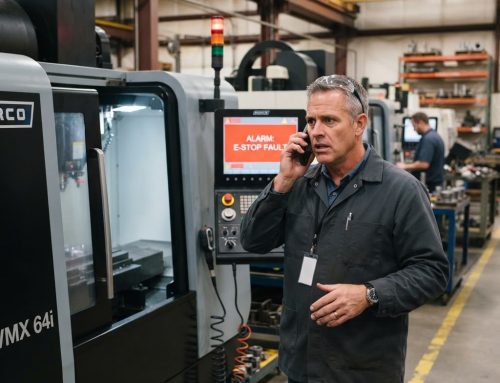
- Axis Drive Overload Alarms: If your CNC control continuously displays servo or spindle overload errors (such as FANUC alarms SV0409 or SV0410), it indicates the motor is working too hard to overcome mechanical resistance. This resistance is frequently caused by seized or severely deteriorated bearings.
n
n
n
n
n
nn
The In-House CNC Service LLC Replacement Process
n
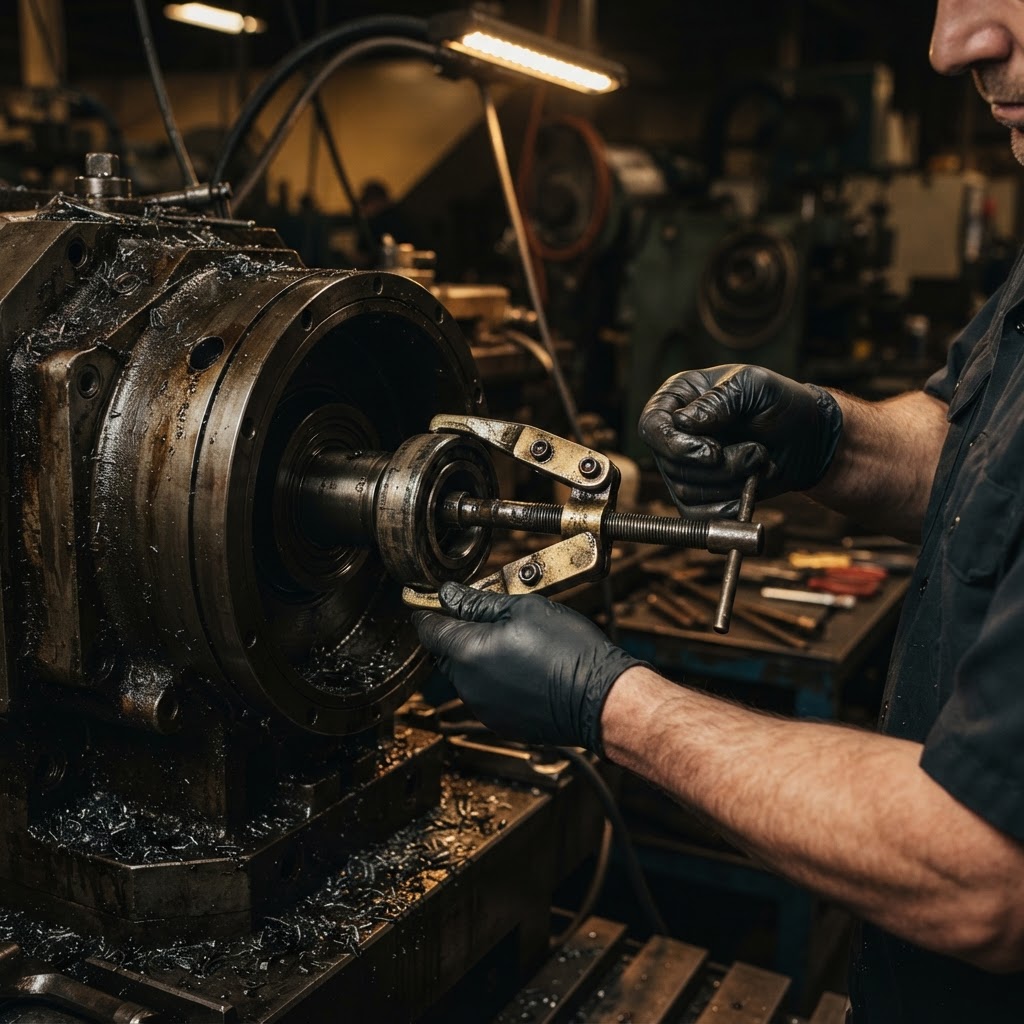
Replacing high-precision CNC bearings is not a job for a general mechanic. It requires specialized pullers, induction heaters, micrometers, and clean-room assembly practices. At In-House CNC Service LLC, our meticulous bearing replacement process guarantees factory-quality results:
nn
1. Vibration and Runout Diagnostics
n
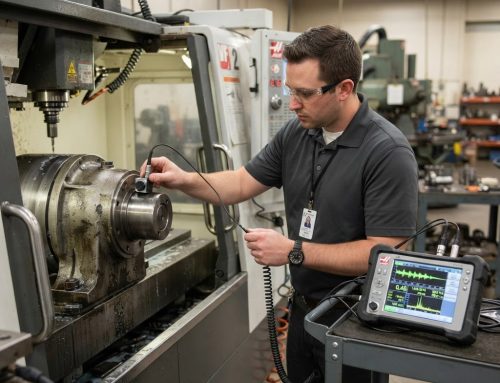
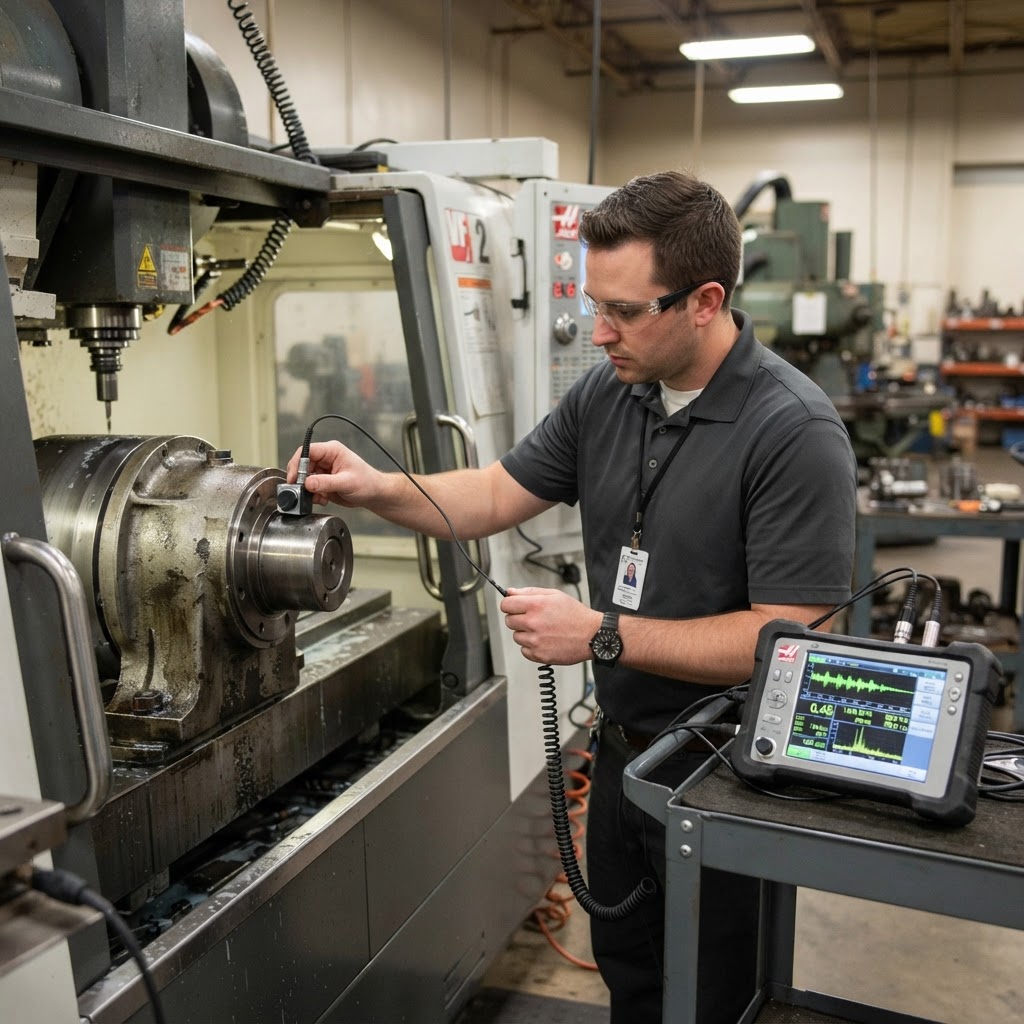
We begin with comprehensive diagnostics. We measure spindle axial and radial runout using high-resolution dial indicators. We also perform vibration analysis to isolate bearing frequencies from motor or gear frequencies, pinpointing the exact location of the damage.
nn
2. Clean-Room Disassembly and Inspection
n
The spindle cartridge or axis housing is carefully dismantled in a clean environment to prevent any airborne contamination. We inspect all surrounding components, including the spindle shaft, housing bores, lubrication lines, and rotary seals, to ensure everything is within OEM geometric specifications.
nn
3. Precision Sizing and Matched-Set Installation
n
We source only high-performance, original equipment manufacturer (OEM) or premium equivalent bearings from trusted brands such as NSK, SKF, FAG, and NTN. Spindle bearings are installed as matched, preloaded sets. We use precise thermal induction heaters to safely expand the bearing inner rings, allowing them to slide smoothly onto the shaft without applying force that could damage the delicate rolling elements.
nn
4. Lubrication and Seal Refresh
n
We repack bearings with the exact OEM-specified high-speed synthetic grease or configure the oil-air mist system correctly. We also replace all critical rotary and static seals to prevent coolant and dust from entering the new bearing assembly.
nn
5. Dynamic Break-In and Run-In Testing
n
New spindle bearings require a strict, gradual thermal break-in procedure. We run the spindle at slowly increasing RPM intervals over several hours while continuously monitoring bearing housing temperatures. This process ensures the lubricant is distributed perfectly and the bearings seat correctly without overheating.
nn
Restore Your Machine’s Precision Today
n
Do not wait for a loud bearing to seize completely and cause catastrophic damage to your high-value CNC machinery. Preventative diagnostics and timely bearing replacement will save your shop time, money, and stress. Contact Jason Wutzke at In-House CNC Service LLC today at (951) 540-4820 or visit in-housecnc.com to schedule your professional CNC bearing replacement California service. We are proud to serve Southern California’s manufacturing corridor, providing on-site, elite mechanical repairs that keep your business moving forward.
n