Thermal Compensation in CNC Machines: Why It Matters for Accuracy
Share Post
The Microscopic Battle Against Heat on the Shop Floor
n
In the world of precision CNC machining, accuracy is measured in ten-thousandths of an inch. When you are machining critical components for aerospace, medical, or defense industries, a variation of just 0.0005 inches can mean the difference between a high-value, compliant part and an expensive scrap metal candidate. While machinists spend hours perfecting tool paths, feed rates, and fixture rigidity, they often face a silent, invisible enemy that constantly shifts their tolerances: heat. The struggle to maintain dimensional stability is one of the most persistent challenges in modern manufacturing.
n
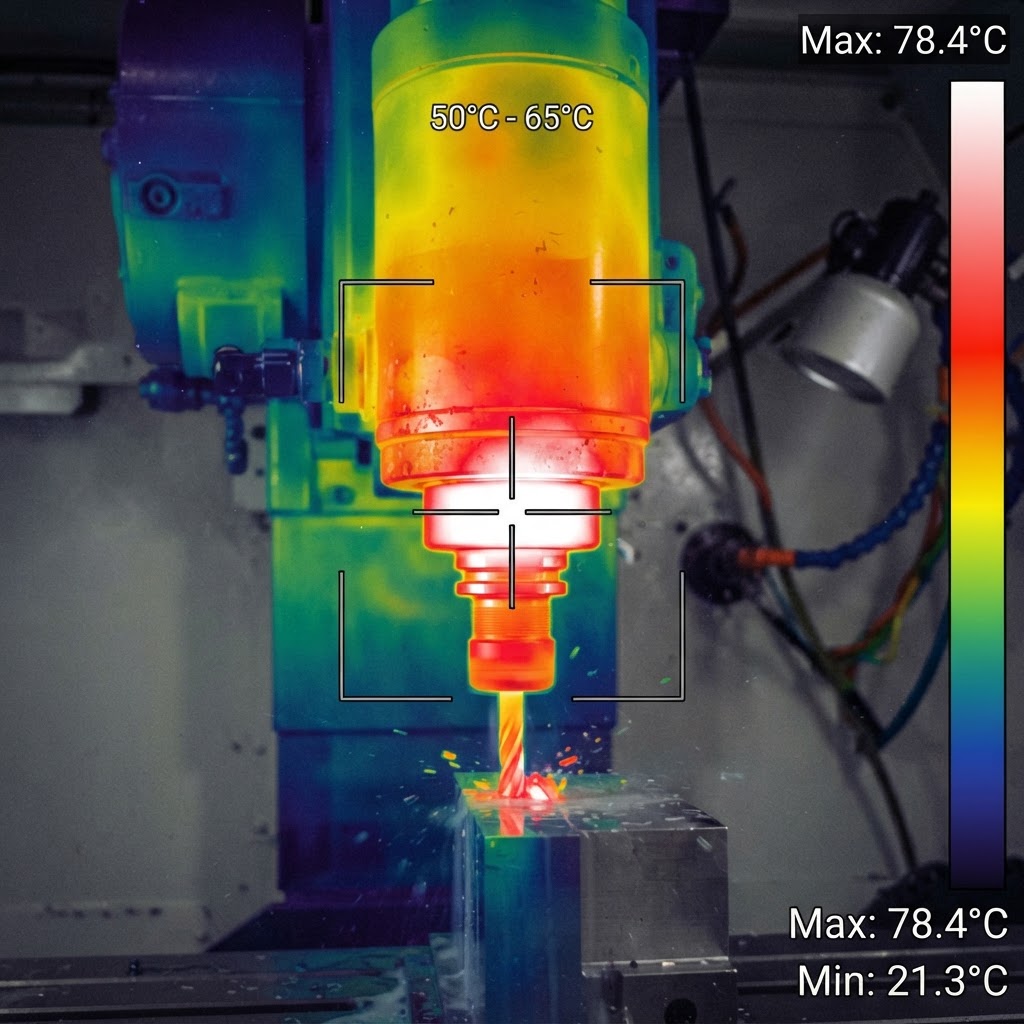
As a CNC machine operates, it generates substantial thermal energy from high-speed spindle rotation, servo motor friction, and axis rapid traverses. This heat causes the machine’s structural components to expand and distort, a phenomenon known as thermal drift. In this article, we will explore the science behind CNC thermal expansion, analyze how thermal drift affects spindles and ballscrews, explain how modern controls compensate for this movement, and discuss the critical maintenance steps required to keep your machine’s thermal compensation systems operating at peak accuracy. Understanding these elements is essential for any shop aiming to produce world-class, high-precision components.
n
Thermal stability is not just about the machine’s internal heat sources; it is also heavily influenced by the environment of your shop. Ambient temperature changes, drafts from large bay doors, and direct sunlight can all introduce external thermal gradients that warp a machine’s frame. To combat this multi-faceted challenge, you must implement a robust combination of internal control compensation, proper mechanical alignments, and structured preventive maintenance. In the following sections, we will break down the mechanics of thermal expansion and show you how to maintain control over your tolerances.
nn
How Heat Affects CNC Machine Geometry: Understanding Coefficient of Thermal Expansion
n
To understand thermal drift, we must look at the physical properties of the materials used to build CNC machines. Most machine tools are constructed from cast iron, structural steel, and aluminum. Every one of these metals is subject to the Coefficient of Thermal Expansion (CTE), which dictates how much the material will expand for every degree of temperature increase.
n
For example, cast iron has a CTE of approximately 0.000006 inches per inch per degree Fahrenheit. This might sound microscopically small, but let’s look at a real-world scenario. If a CNC machine’s cast iron column is 60 inches tall, and its temperature increases by just 15°F during a heavy production shift:n
nExpansion = 60 inches * 0.000006 * 15°F = 0.0054 inches!n
nA structural expansion of over five-thousandths of an inch is a massive deviation in precision manufacturing. If the machine control does not adjust for this expansion, your Z-axis work offset will drift, causing tools to cut deeper than programmed and leading to out-of-tolerance parts, broken tools, and wasted material. This drift is often gradual, making it difficult for operators to detect until a part fails quality inspection.
nn
Thermal Drift in Spindles and Ballscrews: Why It Matters for Accuracy
n
While the entire machine structure expands, two components are particularly susceptible to rapid, localized thermal buildup: the spindle and the ballscrews.n
- n
- Spindle Thermal Growth: A CNC spindle cartridge contains precision angular contact bearings operating at high speeds, often ranging from 8,000 to over 20,000 RPM. This high-speed rotation generates friction, which quickly heats up the spindle shaft and housing. As the spindle heats up, it expands axially (outward from the housing), pushing the cutting tool closer to the workpiece. This thermal growth typically occurs rapidly during the first 30 to 60 minutes of operation, stabilizing only after the spindle reaches thermal equilibrium. Without compensation, your pocket depths and Z-axis features will drift significantly during this warm-up window.
- Ballscrew Elongation: CNC axis movements are driven by precision ground ballscrews. As the axis rapid-traverses and feeds back and forth, the friction between the ball nut and the screw threads generates heat. This heat causes the ballscrew to elongate. Since ballscrews are anchored at one or both ends, this elongation changes the physical position of the axis relative to the rotary encoder, leading to linear positioning errors, circularity errors, and backlash anomalies. This is especially true for heavy-duty roughing cycles that involve rapid, continuous axis movement.
n
n
n
nn
How Modern Controls Compensate: Sensor-Based vs. Algorithmic Thermal Compensation
n
To combat thermal drift and maintain sub-micron accuracy, modern CNC machine manufacturers implement advanced thermal compensation systems within their controls. These systems generally fall into two categories:n
- n
- Sensor-Based (Direct) Compensation: This method utilizes physical temperature sensors (thermocouples) mounted at strategic locations on the machine tool, such as the spindle casting, the machine column, and near the ballscrew support bearings. The CNC control continuously monitors these temperatures in real-time. Using pre-calibrated material expansion formulas, the control calculates the exact physical growth of each component and dynamically offsets the axis positions (X, Y, Z) to compensate for the expansion. This direct feedback loop is highly accurate and handles external environment fluctuations perfectly.
- Algorithmic (Indirect/Mathematical) Compensation: Instead of physical sensors, this approach relies on complex mathematical models programmed into the CNC control. The algorithm estimates heat generation based on real-world operating data, such as spindle RPM, spindle load, axis travel distances, and feed rates. The control then applies a sliding scale of coordinate offsets based on how hard and how long the machine has been running. While less expensive to implement than sensor-based systems, algorithmic compensation is highly effective for standard operating conditions.
n
n
n
nn
Manual Compensation Techniques vs. Automatic Feedback Loops
n
In older CNC machines that lack built-in thermal compensation, machinists must rely on manual compensation techniques to maintain part accuracy. This often involves running a ‘warm-up program’ for 30 minutes at the start of every shift to bring the spindle and ballscrews to operating temperature before cutting production parts. Additionally, operators must frequently measure finished parts and manually adjust tool wear offsets throughout the day as ambient shop temperatures change, which increases labor costs and introduces human error.
n
Modern automatic feedback loops eliminate this manual labor and guesswork. In high-end facilities, CNC machines are integrated with automated probing systems (like Renishaw probes). The machine program can be configured to automatically probe a known reference point or calibration sphere after a set number of parts. If the probe detects a structural shift due to thermal expansion, the control instantly updates the active work coordinate offsets, keeping the machine perfectly calibrated without human intervention. This automatic adjustment is key to running lights-out or unattended production shifts.
nn
Preventive Maintenance Implications: Keeping Thermal Systems Operational
n
Thermal compensation is a powerful tool, but it only works if the machine’s cooling and calibration systems are properly maintained. If your thermal compensation systems are neglected, your accuracy will suffer. Critical maintenance steps include:n
- n
- Spindle Chiller Maintenance: Many high-performance machines utilize an active liquid-glycol spindle chiller to remove heat from the spindle housing. If the chiller fluid is low, dirty, or the chiller radiator is clogged with dust, the spindle will overheat, leading to excessive thermal growth and premature bearing failure. Regular coolant checks and radiator cleaning are essential.
- Calibration Integrity: Over time, the parameters that govern thermal compensation can drift due to mechanical settling or sensor degradation. Precision laser interferometer testing and ballbar analysis should be performed annually to verify machine geometry and recalibrate lead-screw and thermal compensation tables in the control.
- Sensor Check: Temperature sensors can fail or loosen from their mounting surfaces, sending incorrect data to the control and causing erratic axis compensations. Regular electrical checks ensure all sensors are communicating accurately and mounting brackets are secure.
n
n
n
n
nn
In-House CNC Service LLC: Precision Laser Alignment and Geometry Calibration
n
At In-House CNC Service LLC, we specialize in solving complex precision, thermal drift, and geometry issues for machine shops throughout Southern California. Led by Jason Wutzke and based in Menifee, CA, we bring advanced diagnostic tools and deep technical expertise directly to your facility.
n
Our team can inspect, service, and optimize your machine’s spindle chillers, verify physical sensor functionality, and perform precision geometry alignments. We utilize high-resolution indicators and calibration standards to measure and adjust lead-screw compensation and backlash parameters, restoring your machine’s ability to hold tight tolerances all day long, regardless of temperature fluctuations. We work with you to design custom preventive maintenance schedules that keep your machines thermally stable and accurate.
n
Stop chasing tolerances and running long, unproductive warm-up cycles. Let In-House CNC Service LLC restore the precision and thermal stability of your CNC machinery. Contact us today at (951) 540-4820 or visit in-housecnc.com to schedule a precision geometry calibration and preventive maintenance service. We keep Southern California’s manufacturing industry precise, productive, and profitable.