How to Minimize CNC Machine Downtime During a Repair
Share Post
How to Minimize CNC Machine Downtime During a Repair
The Cost of Every Hour Your CNC Machine Is Down
Downtime cost is not just the lost production value of the hours a machine sits idle. It includes overtime required to make up the lost production, expediting fees on late shipments, customer relationship damage, and in extreme cases, contract penalties. For a production machining center running critical parts, downtime cost can easily exceed $500 to $2,000 per hour.
Minimizing downtime during a repair is therefore a direct profit-protection activity. The strategies below apply to everything from the first moments after a fault through the final verification that the machine is back online.
Step One: Act Immediately and Correctly
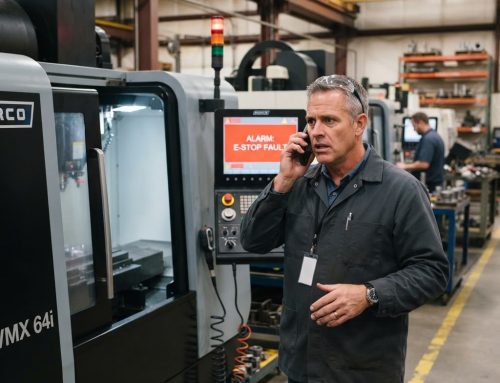
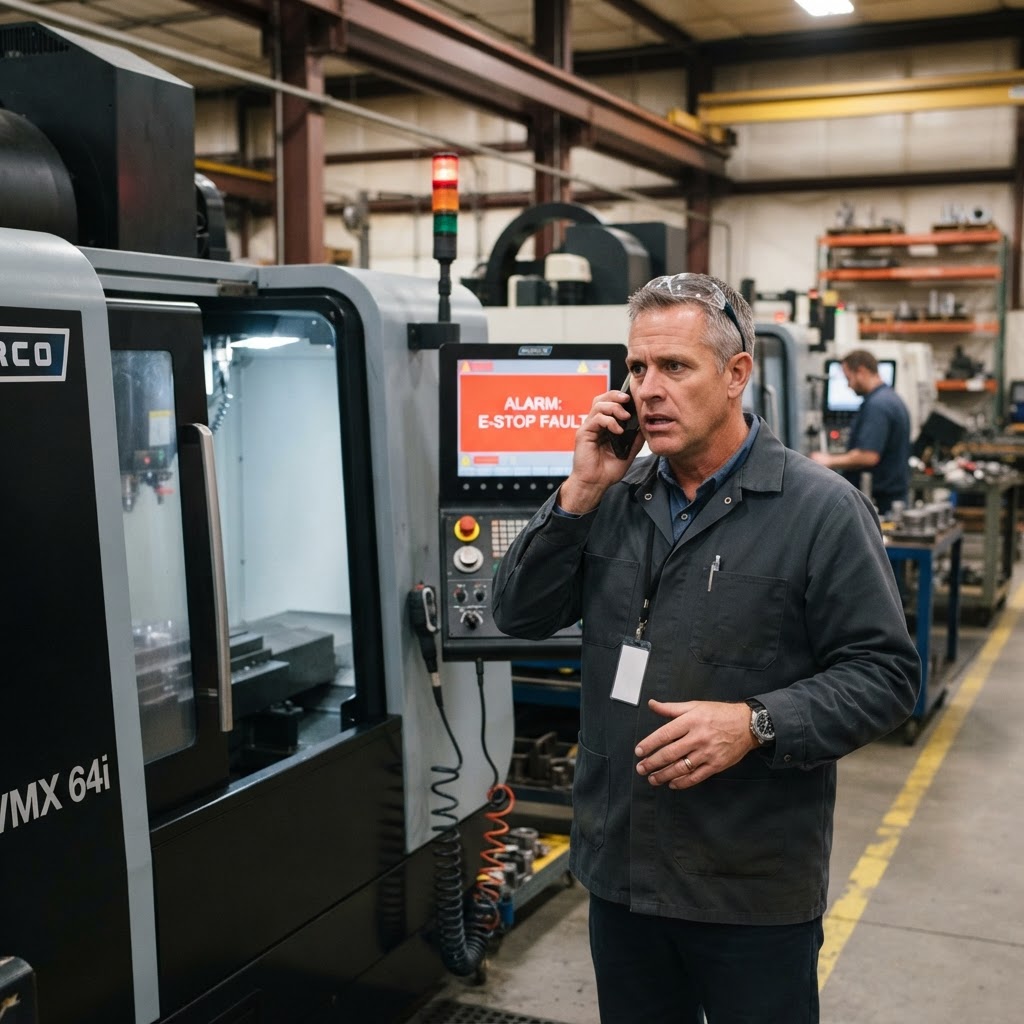
The first thirty minutes after a CNC machine failure have an outsized impact on total downtime. Document the fault codes before cycling power. Call your service provider immediately — not at the end of the shift, not the following morning. The sooner a technician is dispatched, the sooner the clock on diagnostic time starts.
If you have a standing relationship with a CNC repair provider, they may be able to begin remote pre-diagnosis based on the fault codes you provide over the phone — narrowing the component candidates before the technician arrives and potentially shortening the on-site diagnostic time significantly.
Keep Your Machine Documentation Accessible
A technician who must hunt for machine documentation — serial numbers, electrical schematics, controller parameter backups, service history — is burning diagnostic time on administrative tasks. Keep a folder for each machine with its serial number, controller version, last parameter backup, service history, and the most recent maintenance report.
Controller parameter backups deserve specific emphasis. If your machine’s controller loses its parameters — through a power fault, battery failure, or board replacement — having a recent backup can reduce recovery time from days to hours. Schedule parameter backups annually as part of your maintenance program.
Reroute Production While the Machine Is Down
As soon as it is clear the repair will take more than a few hours, evaluate whether any of the affected machine’s work can be rerouted to alternate capacity — another machine in your shop, an outside processing vendor, or a sister facility. Even partial rerouting reduces the production impact of the downtime event.
This analysis requires knowing your machine’s current job queue and which operations can run on alternate equipment. Keeping this information current — not just in production scheduling software but in the operational knowledge of your team — enables faster triage decisions when a machine goes down.
Prepare the Machine and Work Area for Technician Access
When a technician arrives, a machine that is accessible — electrical cabinet unobstructed, work area clear, adequate lighting available — enables faster diagnosis. A machine buried under tooling storage, parked fixtures, and disorganized workholding is going to add time to every step of the diagnostic process.
If access to the machine’s electrical cabinet requires moving adjacent equipment or clearing significant floor space, do that before the technician arrives. That preparation time costs you nothing but recovers it with interest in diagnostic efficiency.
Communicate Clearly and Stay Available
During the diagnosis and repair, the shop manager or maintenance lead should be available to the technician — not hovering, but reachable. The technician may have questions about machine history, recent operational changes, or need approval to proceed with a parts order. Delays in reaching a decision-maker add real time to the repair.
Clear communication about approval authority also matters. The technician should know from the beginning whether they need a specific person’s approval to proceed with parts orders above a certain value. Establishing this at the start of the service call prevents mid-repair delays.
Use the Downtime to Address Other Maintenance Items
While the machine is down for repair, it is also accessible for deferred maintenance tasks that would otherwise require a separate service call. If your technician identifies additional items during the repair — a way wiper needing replacement, a coolant filter overdue for service, a loose connection in the electrical cabinet — addressing them now costs incremental time but avoids a future service call.
This opportunistic approach to downtime maintenance is a practical way to extract value from an otherwise costly event. Discuss it with your technician during the diagnostic phase — before the repair is complete — so any additional materials can be sourced in parallel with the primary repair parts.
Prevent the Next Downtime Event with a PM Program
The most effective strategy for minimizing CNC downtime is preventing it in the first place. A structured preventative maintenance program catches developing issues before they cause failures — and it does so at a time of your choosing, not in the middle of a critical production run.
In-House CNC Service designs PM programs for Southern California manufacturers that match the actual utilization and environment of your specific equipment. A well-executed PM program is the single highest-return maintenance investment most shops can make. Contact us to discuss your current maintenance program and where the highest-impact gaps are.
Your CNC Machine Can't Wait. Neither Can We.
In-House CNC Service dispatches certified technicians directly to your facility across Southern California. No shipping. No guesswork. Just expert repair that gets you back online. The NIST Manufacturing Extension Partnership reports that unplanned downtime is among the top productivity drains for North American manufacturers.