CNC Machine for Gunsmithing: What to Consider
Share Post
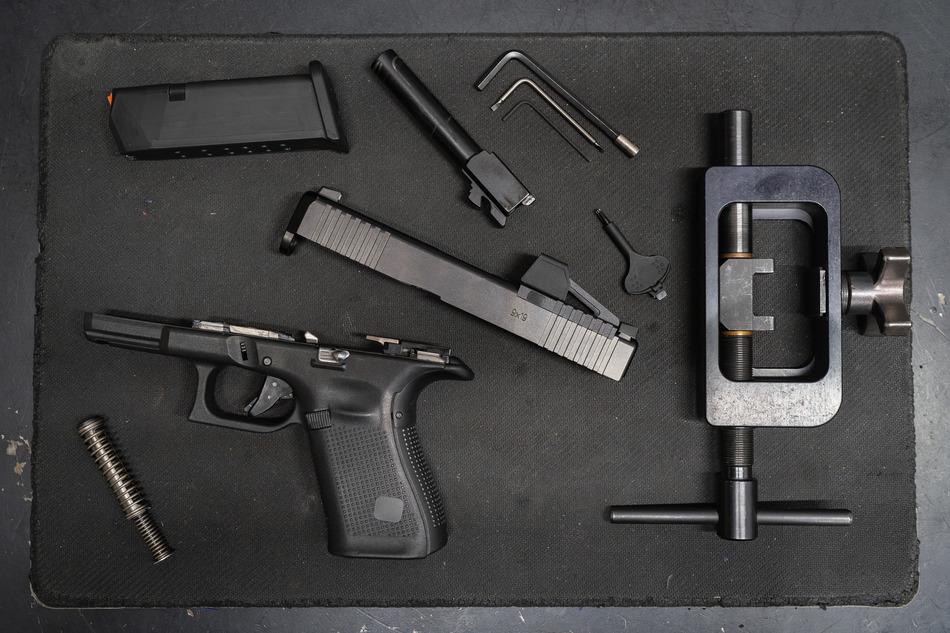
Modern gunsmithing has evolved far beyond files, vises, and drill presses. Today’s precision work—slides, receivers, optics cuts, trigger components, and custom parts—demands tolerances that only CNC machining can consistently deliver.
Whether you’re upgrading from manual equipment or launching a small production shop, choosing the right CNC machine for gunsmithing is one of the most important investments you’ll make. The wrong machine slows you down. The right one transforms your workflow, accuracy, and profitability.
Here’s what to consider before you buy. Our contact our team can address this directly.
Start with the Type of Work You Plan to Do
Not every gunsmith needs the same machine.
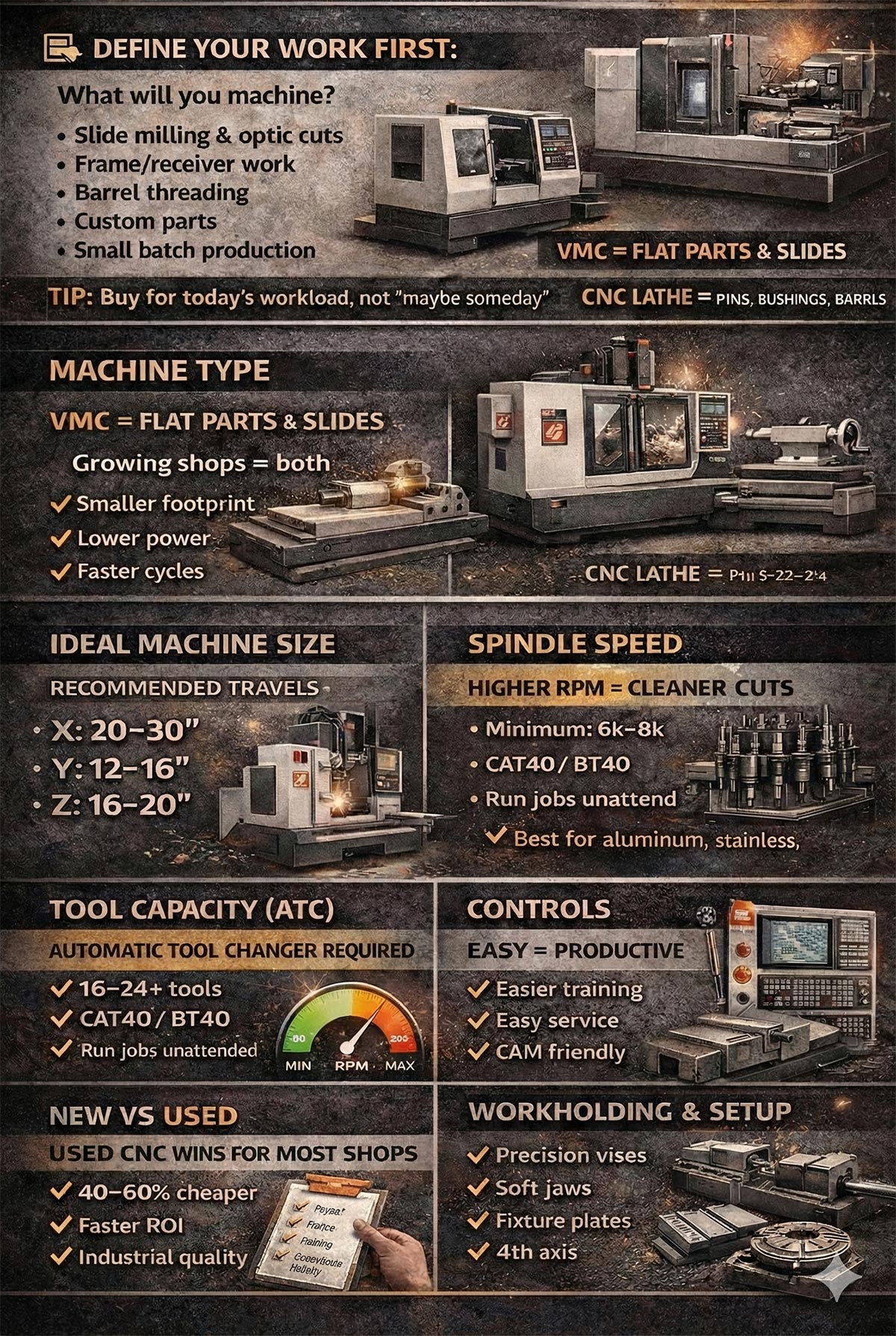
Before looking at specs or brands, define your core services:
- Slide milling and optic cuts
- 1911 or Glock frame work
- Receiver machining
- Barrel threading
- Custom parts production
- Short-run or batch manufacturing
If you’re primarily modifying existing parts, a compact vertical machining center (VMC) may be perfect. If you’re producing pins, bushings, or cylindrical components, a CNC lathe could be just as important.
Many growing shops eventually run both.
Buying for your actual workload, not your “maybe someday” projects, prevents overspending and underutilization.
Machine Size and Footprint Matter More Than You Think
Gunsmithing rarely requires huge travel ranges, but rigidity still matters.
Most shops do well with:
- 20–30” X travel
- 12–16” Y travel
- 16–20” Z travel
This comfortably handles slides, frames, small fixtures, and multi-part setups without taking up unnecessary floor space.
A smaller machine also means:
- Lower power consumption
- Easier installation
- Lower tooling costs
- Faster warm-up and cycle times
For many gunsmiths, a compact VMC outperforms a large industrial machine simply because it fits the workflow better.
Precision and Repeatability Are Non-Negotiable
Firearm components demand tight tolerances and perfect alignment. Even small deviations affect fit, safety, and performance.
Look for:
- ±0.0002″–0.0005″ repeatability
- Rigid cast iron construction
- Ball screws in good condition
- Minimal backlash
- Stable thermal performance
This is where machine quality matters more than horsepower.
A solid, well-maintained used industrial machine will often outperform a brand-new entry-level hobby machine.
Spindle Speed: Faster Is Usually Better
Gunsmithing often involves:
- Aluminum slides
- Stainless steel
- Tool steel
- Small cutters and engraving tools
Higher RPMs give you cleaner finishes and better tool life.
Ideal spindle speeds:
- Minimum: 6,000–8,000 RPM
- Preferred: 10,000–12,000+ RPM
If you plan on micro-engraving, light pocketing, or detailed contouring, higher speed is a huge advantage.
Tool Capacity Saves Time
Constant tool changes kill productivity.
A machine with an automatic tool changer (ATC) is a must if you plan to do production or repeat jobs.
Look for:
- 16–24 tools minimum
- Reliable carousel or side-mount ATC
- Common taper (CAT40 or BT40)
More tools mean you can load:
- Roughers
- Finishers
- Chamfer tools
- Engravers
- Drills
- Taps
…and run complete jobs unattended.
That’s where real efficiency shows up.
Control System and Ease of Programming
If you’re a gunsmith first and machinist second, you don’t want to fight your control.
User-friendly systems like:
- Haas
- Fanuc
- Okuma
- Mitsubishi
are widely supported and easy to learn.
They also make it easier to:
- Find training
- Hire operators
- Get replacement parts
- Integrate CAM software
Avoid obscure or unsupported controls that make repairs difficult later. Our CNC repairs and troubleshooting can address this directly.
New vs. Used: Where Most Shops Win
Brand-new machines are great—but they’re expensive.
For many gunsmiths, a quality used industrial CNC is the smarter move.
Benefits of used:
- 40–60% lower cost
- Proven reliability
- Faster ROI
- Access to higher-end models for the same budget
A well-maintained used Haas, Okuma, or Mazak will outperform many entry-level new machines at the same price.
Just make sure you verify:
- Maintenance history
- Spindle hours
- Backlash and accuracy
- Control condition
- Power-on tests
Buying from a vetted reseller or dealer reduces risk significantly.
Workholding and Fixturing
The machine is only half the equation.
Gunsmithing often requires custom fixtures to hold small or irregular parts safely.
Plan for:
- Precision vises
- Soft jaws
- Modular fixturing plates
- Rotary tables or 4th axis
- Dedicated slide/receiver fixtures
A 4th axis can dramatically expand what you can do in a single setup, especially for multi-side machining.
Shop Infrastructure
Don’t forget the practical stuff.
Make sure your shop can support:
- Proper power requirements (3-phase if needed)
- Air supply
- Coolant management
- Chip evacuation
- Adequate space for loading and service
Installation costs can sneak up if you don’t plan ahead.
ROI and Business Growth
A CNC isn’t just a machine—it’s a revenue tool.
Ask yourself:
- How many jobs per week will this replace?
- How much labor will it save?
- Can I offer new services (optic cuts, custom parts, engraving)?
- How fast will it pay for itself?
Most small gunsmith shops see ROI faster than expected simply by adding repeatable, higher-margin services.
Final Thoughts
The best CNC machine for gunsmithing isn’t the biggest or most expensive—it’s the one that fits your workflow, space, and business goals.
Focus on:
- Rigidity
- Precision
- Adequate travel
- High spindle speed
- Reliable control
- Strong resale or service support
Buy smart, set it up correctly, and your CNC becomes one of the most valuable tools in your shop.
Done right, it doesn’t just improve quality—it changes what your business is capable of producing. Our retrofitting and upgrades can address this directly.